
The beginner's guide to contrast therapy in Austin
What to know before your first session, and the four mistakes almost everyone makes.
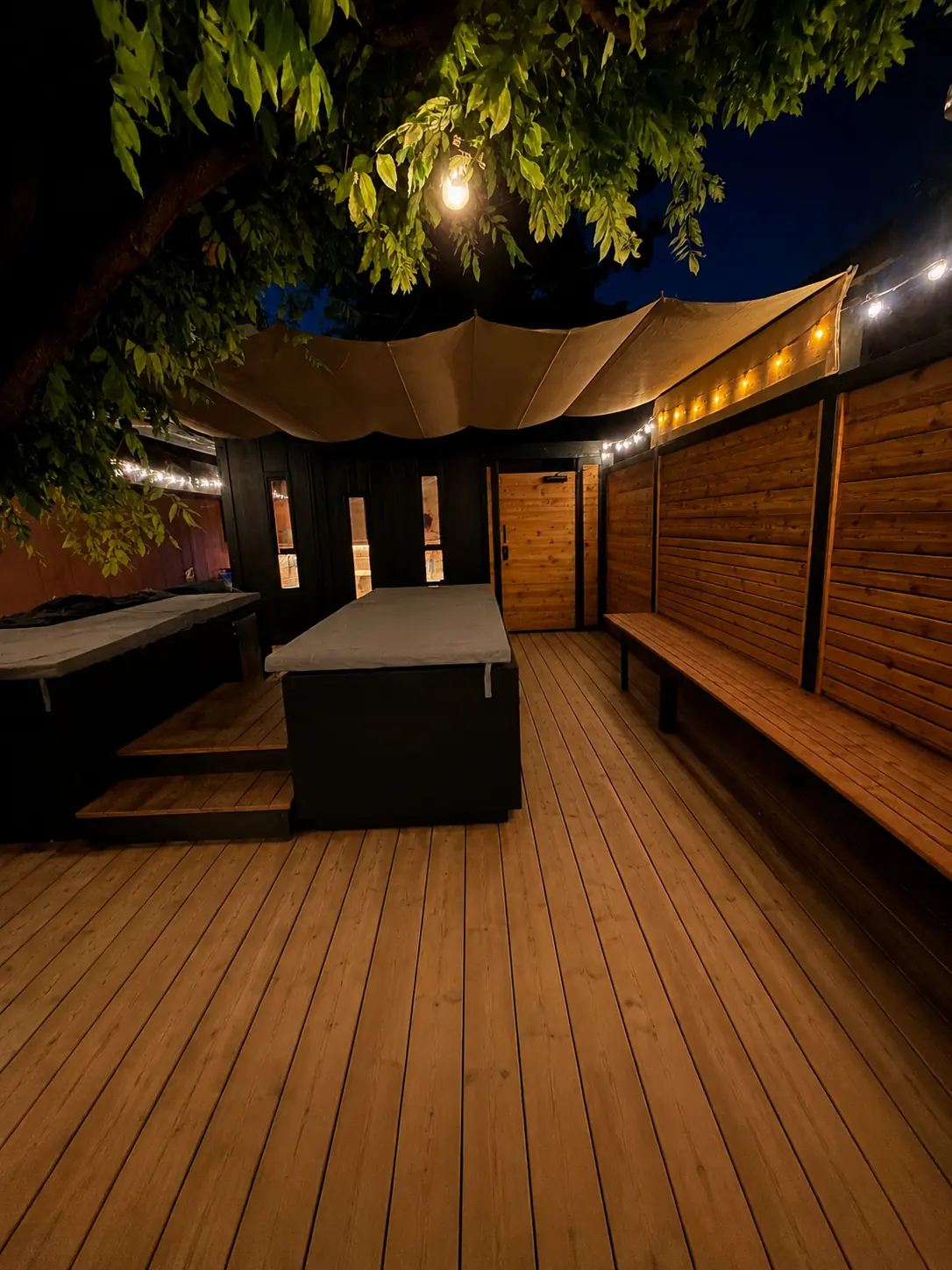
If you've spent any time on the internet in the last five years you have been told that cold plunging will fix your mood, your metabolism, your soreness. Some of that is true. Most of it is oversold. And almost none of it tells you the thing you actually want to know when you're standing in swimwear next to a 45° tub for the first time, which is: how long am I supposed to be in there, and what happens if I get out early?
Here's the practical version, written from a cedar room in the center courtyard of Casa de Luz Village.
What contrast therapy actually is
Contrast therapy is deliberately cycling your body between significant heat and significant cold, with real rest in between. Not a hot shower and a cool rinse — a genuine swing. At Sweatcity that means a cedar sauna held at 185°F and cold plunges at 45°F and 55°F.
The heat opens you up. Blood vessels dilate, heart rate climbs into a zone that looks a lot like moderate cardio, you sweat hard, and your body starts working to shed temperature. The cold does the opposite, violently: vessels clamp shut, blood is pulled toward your core, your breathing tries to run away from you, and your nervous system floods with norepinephrine.
Then you sit down and do nothing, and your body reverses all of it on its own. That reversal — the slow re-warming from the inside — is where most of the interesting stuff happens, and it is the part everyone rushes.
The rest isn't the boring part between the good parts. The rest is the part.
The protocol, round by round
One round looks like this:
1. Rinse — with soap, before anything
Mostly for you, and a little for everyone else. Sunscreen, lotion, body oil, and the day's sweat all come off in the plunge otherwise, and the cedar in the sauna absorbs whatever you bring in. Sixty seconds, warm water, all of you. It also raises your skin temperature, so you'll break a sweat several minutes sooner. We wrote a whole piece on why this habit exists in four separate cultures.
2. Sauna — 10 to 15 minutes at 185°F
Start on a lower bench. Heat stratifies hard in a cedar room and the top bench can be twenty degrees hotter than the one below it — there's no prize for starting at the ceiling. Breathe normally. Let the heat come to you rather than bracing against it.
If you want it more intense, water on the rocks produces löyly — the burst of steam that spikes humidity and makes 185° feel considerably more like 205°. Ask the room first. That steam changes the temperature for everyone on every bench, and it is the single most common way a well-meaning person annoys a sauna.
3. Rinse again — ten seconds
Knock the sweat off before you get in the cold water. It keeps the plunge clean, and it takes real edge off the cold shock, because your skin isn't sitting at 105° when it hits 45°.
4. Plunge — 1 to 3 minutes
Get in deliberately. Don't jump, don't psych yourself up for ninety seconds on the step, don't let anyone count you down.
The gasp you feel when you go under is the cold shock response, and it is automatic — it isn't weakness and it doesn't mean you're doing it wrong. The way you shut it down is a long, slow exhale as you submerge. Get your shoulders under. If your hands are what's screaming, hold them out of the water; the palms carry a huge share of the panic signal.
Our 55° plunge is the on-ramp and our 45° is the real thing. If you want the most intense version, river mode circulates the water around you, stripping away the warm boundary layer your body builds against still water. It is a completely different experience at the same temperature.
5. Rest — 5 to 10 minutes
Sit in the courtyard. Don't towel off aggressively, don't go straight back into the heat, don't check your phone. You will start shaking a little and then stop, and you will feel a warm flush move outward from your chest. That's the whole thing. Water and electrolytes here, not after.
Then repeat. Two to four rounds is a normal session — call it 45 to 75 minutes. A one-hour booking is comfortably three rounds if you keep moving.
Your first session, specifically
Cut every number above roughly in half:
- 8–10 minutes in the sauna, lower bench
- 30–60 seconds in the 55° plunge — not the 45°
- Two rounds, not four
- Then go sit in the courtyard and drink something
You are not proving anything on day one. You're finding out what your baseline is so you have something to move. Come back Thursday and add thirty seconds.
Four mistakes almost everyone makes
1. Treating the cold as a competition
Five minutes in the plunge is not five times better than one minute. Past a certain point you're just accumulating cold, and the returns flatten out fast while the risk doesn't. The people who last years at this are almost never the people who went hardest in week one.
2. Skipping the rest
The most common version: heat, cold, heat, cold, done, out the door in thirty-five minutes. You got a workout. You didn't get contrast therapy. Rest roughly as long as you sweated.
3. Doing breathwork in the water
This one matters more than the others. Hyperventilation or breath-hold protocols combined with cold water immersion is a genuinely dangerous combination — it can drop your CO₂ enough to cause a blackout, and blacking out in water is how people drown in three feet of it. Breathe slowly. Long exhales. Never hold your breath. Do your breathwork on dry land, before or after, never in the tub.
4. Plunging immediately after lifting
If your goal is muscle growth, cold immersion right after resistance training may blunt some of the adaptation you just earned. Several studies point this direction. It's not a reason to skip the cold — it's a reason to put an hour or two between the barbell and the ice, or to plunge on days you didn't lift. Endurance athletes generally don't have this problem, and if your goal is feeling better tomorrow rather than maximum hypertrophy, plunge whenever you like.
How to finish
Ending on cold leaves you alert and buzzing for hours — a great morning session. Ending on heat plus a long rest leaves you soft and sleepy — better if you're headed home to bed. Both are correct. The mistake is not choosing.
How often, and when
The observational sauna research that gets cited most — a long-running Finnish cohort study — found the association with cardiovascular outcomes scaled with frequency. Four to seven sessions a week looked better than two to three, which looked better than one. That's association rather than proof, but the direction is consistent and the mechanism is plausible.
Practically: two to four sessions a week is a great place to live. That's roughly where a membership stops being a luxury and starts being cheaper than the drop-ins, which is not a coincidence — it's the frequency we actually want people at.
For cold specifically, the working guidance is a modest weekly total — on the order of ten to fifteen minutes of genuinely cold immersion spread across the week, not accumulated in one heroic sitting.
Time of day: morning if you want the alertness, evening if you want the sleep. Austin summer makes a strong case for evening either way.
Who should skip it
Talk to your doctor first if you're pregnant, have a heart condition or a history of arrhythmia, have uncontrolled blood pressure, have a seizure disorder or a history of fainting, or take medication that affects how you regulate temperature — diuretics, beta blockers, sedatives, stimulants. Skip it entirely if you've been drinking, if you're running a fever, or if you're badly dehydrated.
Get out immediately if you feel dizzy, nauseous, confused, short of breath, tingling in the hands or face, or any chest discomfort. There is no version of pushing through that ends well.
We run a sauna, not a clinic — none of this is medical advice.
Come try it. We're in the center courtyard of Casa de Luz Village at 1701 Toomey Road, open daily 9am to 9pm, walk-ins welcome. Drop-ins are $49 and include everything. Tell whoever greets you that it's your first time and they'll walk you through every step above in person — which is, honestly, easier than reading about it.